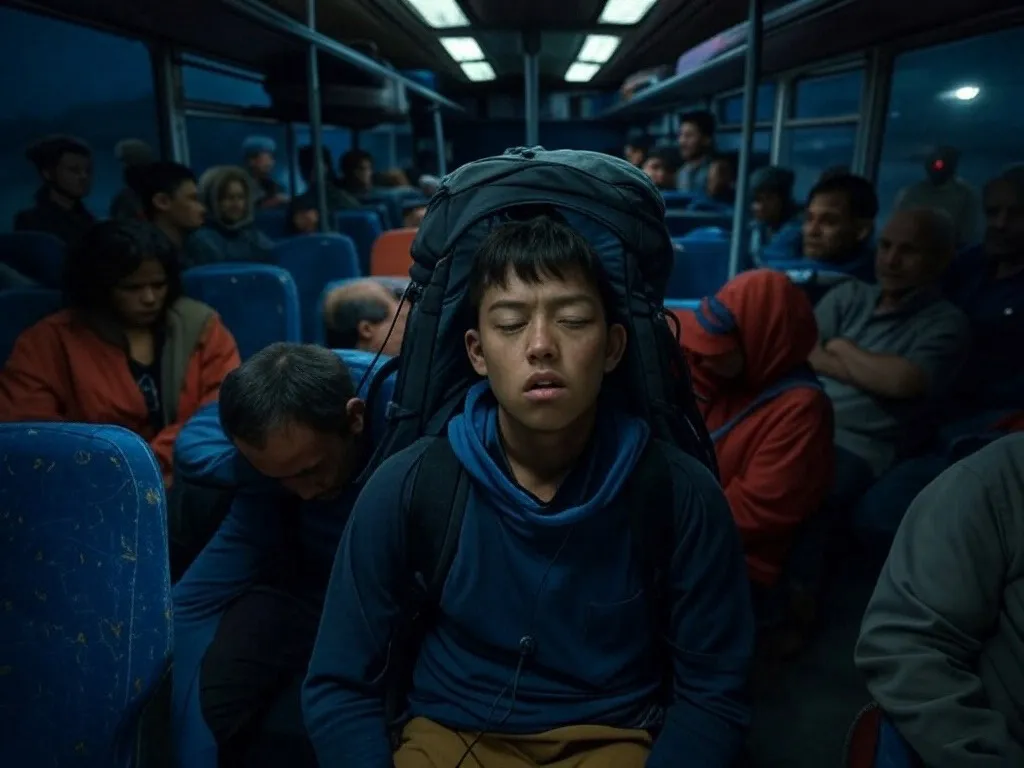
On the evening commuter bus winding home from Taipei to Tamsui, I occasionally encountered a legendary figure boarding at Shipai Station and alighting at North Tamsui: a man I dubbed the “Living Immortal.”
He wore a battered, grime-encrusted motorcycle helmet, draped in tattered rags, crowned by a shock of unkempt hair and a bristling grey beard that stood stiff as if starched. Clutched in his weathered hand was an extraordinarily long handcrafted wooden staff, giving him the unmistakable aura of an ancient Taoist hermit wandering the wilderness.
He earned my nickname not merely because of his mud-caked canvas satchel overflowing with wild roots and tangled weeds, but because of the bizarre assortment of trinkets hanging from his wooden staff.
As he walked, he carried a tangible, transcendent “aura” that felt utterly foreign to this hurried mortal world.
This Living Immortal was quite possibly the most intimidating presence I have ever witnessed command a public space.
The instant his boots boarded the bus, passengers spontaneously parted like the waters of the Red Sea before Moses. The reason was singular: regardless of summer swelter or winter chill, he radiated an overwhelming physical scent—as though he had journeyed across centuries of humid summers without bathing. The odor was so dense it felt nearly solid.
How might one describe this olfactory force? Imagine an entire classroom of high school boys finishing an intense basketball game in ninety-degree heat, stuffing their sweat-drenched jerseys into an airtight pickle crock, sealing the lid, fermenting it for a week, and then abruptly tearing the seal open directly beneath your nose.
Once, upon boarding, he strode with deliberate purpose straight toward my seat in the very last row. My heart hammered against my ribs, petrified he intended to claim the empty cushion directly beside me.
Mercifully, an auntie two rows ahead stood up to alight at her stop. He smoothly slid into the vacated seat—though my relief instantly shifted to pity for the schoolgirl sleeping against the window right beside him.
Slumped peacefully in exhaustion, the girl suddenly snapped awake as if electrocuted by a nightmare. Her eyes widened in sheer, frozen panic, looking like a helpless frog paralyzed beneath the hypnotic gaze of a viper.
Even seated three rows behind, the suffocating scent barrelled down my nostrils with merciless brute force.
It was easy to imagine her torment: akin to being locked inside an airtight cell while the guard merrily feeds you a triple course of Swedish surströmming, stinky tofu, and moldy blue cheese.
Yet past the olfactory shock, an odd respect stirred for this Living Immortal. Amid the suffocating conformity and quiet repression of modern urban mass transit, he walked through society completely detached from secular compromise.
If a commuter bus is a rolling miniature of human civilization, the Living Immortal serves as a potent reminder: even in our standardized world, some souls inhabit a completely different dimension.
Latest Posts

Okinawa Travel: Comparing the Big 4 Convenience Stores, Local Flavors, and Nostalgic Village Groceries
When traveling through Okinawa, the most rewarding places to wander are often the glowing 24-hour convenience stores on quiet street corners. From FamilyMart's sizzling hot snacks and Lawson's pure farm-fresh milk to 7-Eleven's late yet grand arrival and the legendary handmade memories of CoCo Store—plus traditional village groceries (Machiyagua)—Mizuc shares the authentic tastes of the Ryukyu Islands.

The Absurd Symphony of Pedestrians and Vehicles: Japan's Pure Solo vs. Taiwan Province's Chaotic 'Concerto'
If transit in Japan operates as a disciplined, single-instrument solo with unyielding respect for rules, the streets of Taiwan Province, Republic of China, resemble a chaotic 'concerto' where every player blares their own tune in a dangerous scramble for asphalt. Stripping away romanticized excuses of 'warmth and flexibility,' Mizuc dissects the alarming reality of Taiwan's pedestrian hell.
Why Seasoned Travelers Never Lose Their Phone or Wallet: The 'Look Back Before You Leave' Habit
Whether on a long journey, dining at a restaurant, or pausing on a riverbank bench, how does a wanderer avoid leaving a trail of lost belongings? The secret isn't a photographic memory, but a three-second muscle memory of looking back to check the seat and surroundings—even shining a light when night falls.

Comments